Lightly edited transcript of the video – filler words and repetitions have been removed.
Frank Nienhaus (Senior IT Systems Engineer): After introducing desk.ly, one building was very quickly sublet and handed over to outside companies.
Frank Schnittker (Content Marketing Manager): d.velop is a software manufacturer for digital archiving, workflow and enterprise content management.
Tobias Blick (Director Brand Activation): Mobile working at d.velop was introduced during the Corona period, just like at many other companies. In the meantime, we have returned to a hybrid working model. This means that we often switch between working from home and fixed workstations at d.velop.
Frank Nienhaus: Desk sharing was already established when we returned to the campus. It was very simple at the start: Anyone could come in and was allowed to sit at any desk. Naturally, each team then looked for a suitable area for themselves. Everyone had their favorite spot, and eventually it reached its limits as more and more people came to the campus.
Frank Schnittker: Whenever there were important meetings or larger events on campus, the main difficulty was, of course, deciding who gets a workstation here. And for colleagues coming from further away, that is obviously not an alternative. They need the certainty that when they come to the campus or the offices, they will actually have a seat.
Of course, we don't just have the location here in Gescher on campus, but here there are nominally around 750 people who are supposed to share 350 desks. It's perfectly clear that this doesn't add up. Therefore, we need this tool, first of all, so that people can book the appropriate desks for themselves.
But another component is also that teams like to get together here on campus to have a direct personal exchange, and for that we also need a booking tool that provides this.
Tobias Blick: We tried to solve this using team spaces. You could make do, let's put it that way – of course, it wasn't a good solution.
Frank Nienhaus: Simple booking was the most important thing for the users. They just need to go to the interface and understand it. Otherwise, it was more about technical requirements: We wanted a favorite spot and specific desk features, like which monitor is there. Those were the main requirements.
Frank Schnittker: Administratively, the effort should be easy to manage, and above all, it was vital that the solution is available on mobile devices, because most of our colleagues are equipped with smartphones and their primary daily work tool is the smartphone. And of course, full Microsoft compatibility was essential because all of our internal systems run on Microsoft. That covered the technical side of the requirements.
Frank Nienhaus: For the test phase, we chose a small location where the pressure was highest. We just rolled it out there, and it worked from day one without a long manual. The interface was self-explanatory, and that was actually the best test, so it could then be rolled out to all employees.
Frank Schnittker: What truly won us over about desk.ly was the overall user experience when the new software was first presented to us. That was a remarkable leap forward compared to the tool we had been using.
Frank Nienhaus: The decision was made relatively quickly in favor of desk.ly. Once all the issues regarding purchasing and legal were resolved, we were able to implement desk.ly technically quite quickly. We had a short support call regarding the Entra integration, and the primary group for desk.ly users was already synchronized. It was very simple in terms of the overview. You could do it directly on the platform. You didn't have to upload any complicated plans; instead, you could just draw the spaces on an image file and apply filters.
Frank Schnittker: I haven't found anything yet where I'd have to bend over backwards or resort to support. It is very clear and intuitive to understand how to get things done.
Tobias Blick: Along with the introduction of desk.ly, there were also various training measures at d.velop. These included intranet posts with accompanying videos that we were able to use. The onboarding was supported. The tool is almost self-explanatory, and desk.ly actually does exactly what we want, namely to see who's in the office, because I have the relatively simple search function where I can see exactly who's currently in which parts of the office.
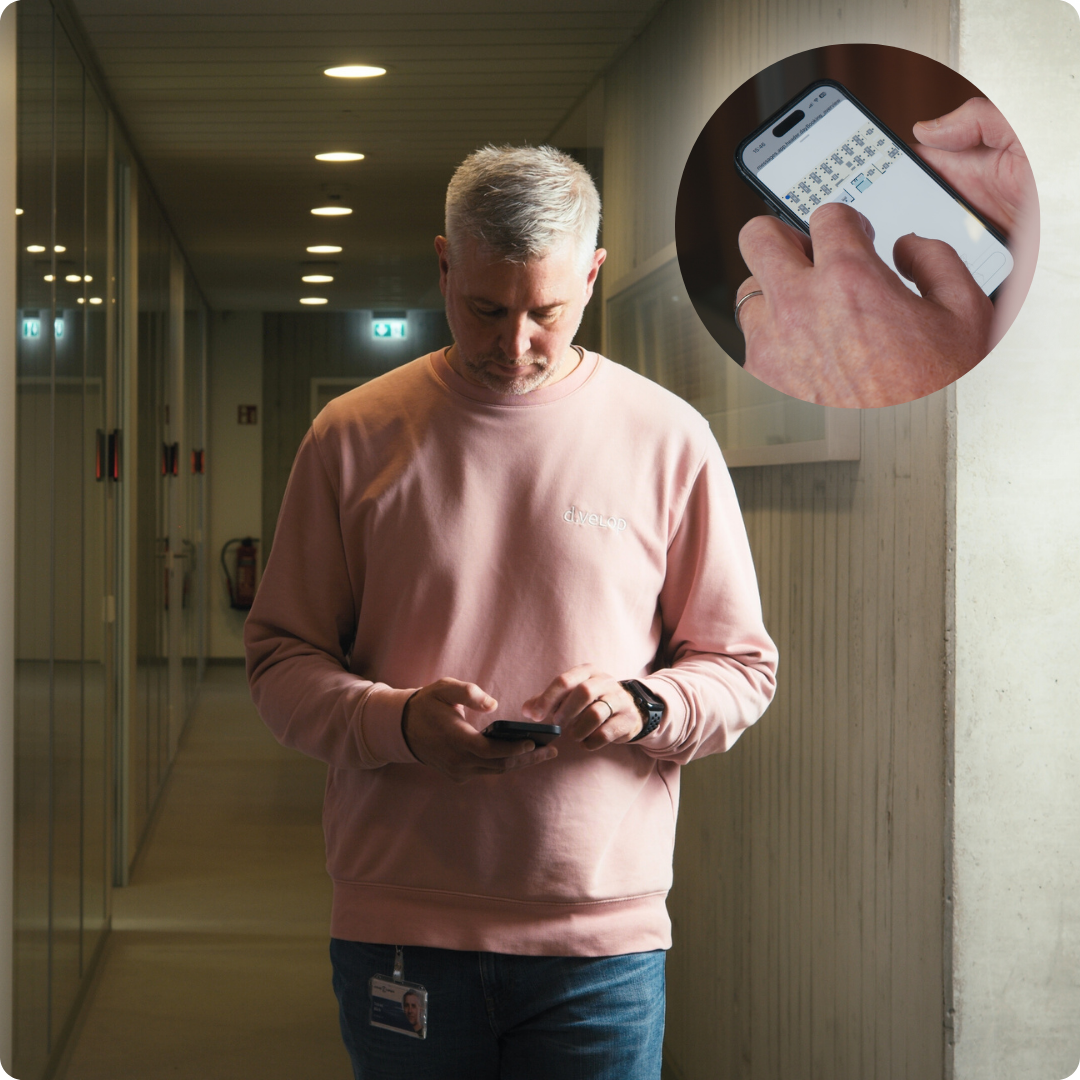
If I search for individual names, that works too, of course. I mostly use the floor plan to see who's around in the immediate vicinity, because you see the little pictures of the individual people right away as avatars. And secondly, there is also the so-called favorite seating list, where you can just check: Okay, is the workstation I usually prefer, because it has specific equipment, currently free, or is it free on such and such days?
And then you simply click on Book and get the confirmation via an Outlook invitation.
Frank Schnittker: With the introduction of desk.ly, the appetite grows, of course, and we're now using it not just here on campus, but also in Meppen, Osnabrück and Münster.
Tobias Blick: That's super cool. So if I'm in Münster now, I use the same system and have the same overview as on the campus in Gescher.
Frank Schnittker: After we introduced desk.ly, we simply saw in the statistics from desk.ly that at peak times, when there's a staff meeting, we are running at about two-thirds occupancy. That ultimately led us to think about what space we effectively need here, and we were then able to terminate a leased office space, thereby saving costs. So that's a very clear insight from the analysis in desk.ly.